JULIE FRAGAR
ONE & THE MANY
2026 MELBOURNE ART FAIR
19-22 February, 2026 / Preview & Vernissage 19 February / Melbourne Convention & Exhibition Centre, South Wharf, Melbourne. {PurchaseTickets}
Click Here for Electronic Catalogue.
Across cultures and throughout history the ‘collective’ has been shaped through ritual and gatherings that organise bodies in space, assign roles and test our belonging. Within those established structures the individual is never separate and meaning takes root not in isolation, but in relation to the other.
The modern self however, conceived as singular and autonomous, stands in stark contrast to this history. Documentary-maker Adam Curtis has long examined our contemporary condition in which the ‘self’ becomes the primary organising force of contemporary life. The 20th and 21st centuries have seen the rise of a notion of the individual who, while still shaped by class, role, location, and ritual, no longer sees themself as a cog within the larger machine, but as a self for whom personal identity and expression must take precedence. And in 2026, individuality operates less as a trait than as a faith, and something to be continually asserted, curated and defended.
One of the most enduring social networks is the family, a group we spend our lives oscillating between the desire to escape from, and the fantasy of return. Our family establishes a template for later social life, teaching us how to belong, to withdraw, and how difficult it can be to locate oneself within a group.
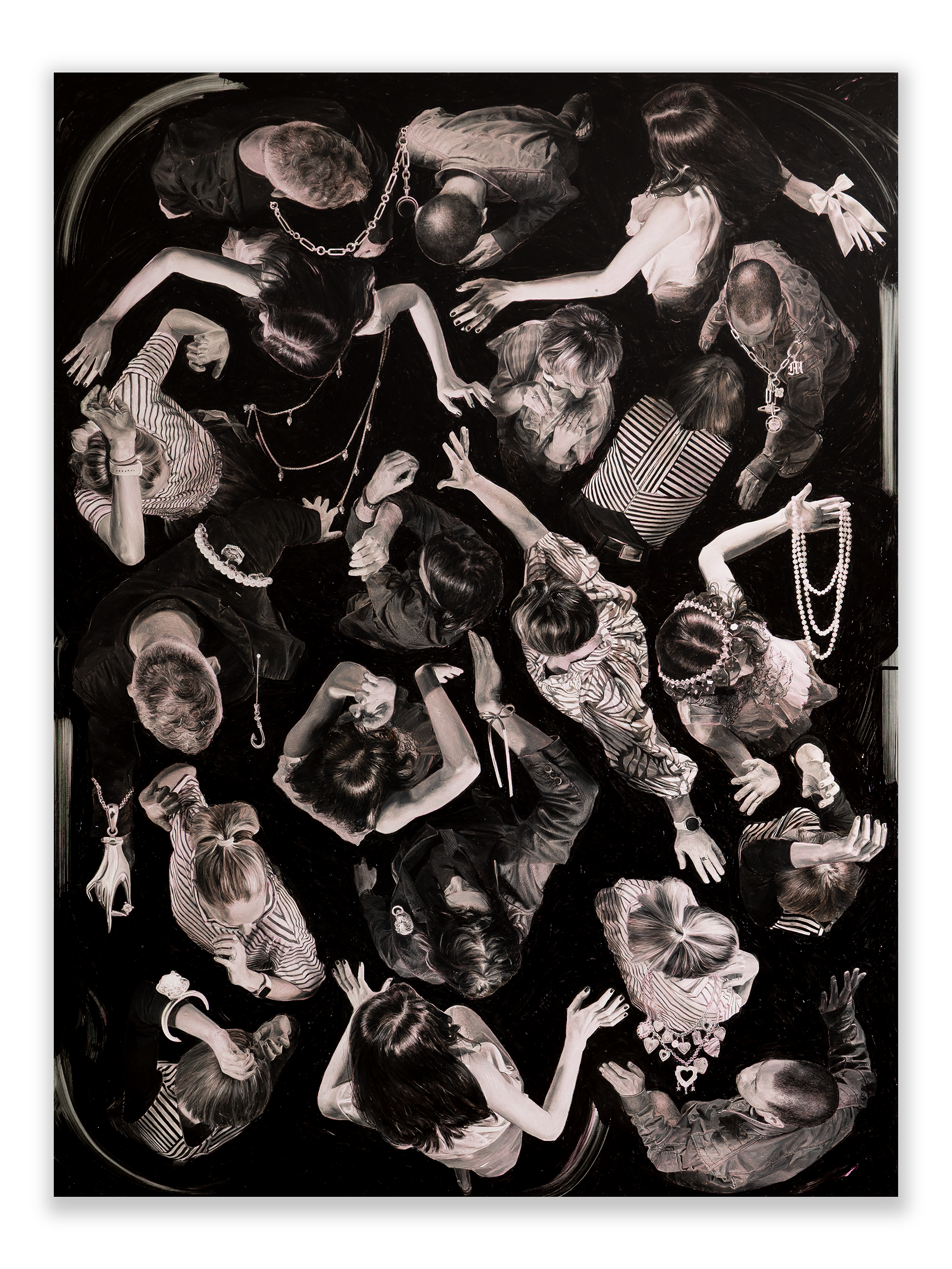
Fragar’s new body of work ‘Other People’ begin with people gathered together. They cluster and disperse. They perform small gestures that feel instinctive rather than posed. A turned head. A hand hovering. A body edging closer or withdrawing. Nothing here is overtly dramatic, yet everything feels charged.
Fragar’s paintings could be seen as an investigation into vantage point; where one stands in relation to others, and what that position allows (or refuses) us to see. The figures in her paintings are not portraits in the traditional sense, nor are they characters in a fixed narrative. They are participants in situations shaped by choreographed proximity and where social forces seem to act upon bodies, arranging them in relation to one another. Across the paintings, groups form and reform. Sometimes they appear orderly, almost rehearsed, whilst at other times they are held under pressure.
While her scenes might appear carefully staged, they are deliberately unsettled. Bodies interrupt one another, gestures misfire, and what emerges are not polished collective performances but constructed records of social friction and moments where collective choreography falters and individual impulses rise to the surface. These layered images resist easy entry. Like a crowded social gathering, they ask us to scan for an opening; a point of easy access that often remains elusive.
Contemporary social life asks us to recognise others as individuals with distinct needs and inner lives, whilst simultaneously navigating the demands of larger groups that carry their own histories, expectations and pressures. No matter how empathetic or connected we might feel, we operate from within our own bodies, bound to a singular point of perception/vantage point from which all understanding begins. We become aware of their own position in relation to these images and to Fragar’s subjects, neither fully inside the group nor safely outside it, but hovering somewhere in between.
Consumed as a body of work, ‘Other People’ registers a familiar paradox. Each of us stands at the centre of our own lived universe, even as we move within a larger choreography that we are constantly navigating, shaping, and being shaped by. In this way, Fragar’s paintings do not so much resolve the tension between the collective and the self as they sustain it. Her images remain open and unsettled, alive to our own vantage point and to the shifting, often uncomfortable realities of being with others.
Fragar's work, held in major public collections across Australia, offers the audience a raw, introspective and often unsettling narrative whilst exploring how individual experiences may be reflected and magnified within the collective consciousness.
![]()
Click Here for Electronic Catalogue.
Across cultures and throughout history the ‘collective’ has been shaped through ritual and gatherings that organise bodies in space, assign roles and test our belonging. Within those established structures the individual is never separate and meaning takes root not in isolation, but in relation to the other.
The modern self however, conceived as singular and autonomous, stands in stark contrast to this history. Documentary-maker Adam Curtis has long examined our contemporary condition in which the ‘self’ becomes the primary organising force of contemporary life. The 20th and 21st centuries have seen the rise of a notion of the individual who, while still shaped by class, role, location, and ritual, no longer sees themself as a cog within the larger machine, but as a self for whom personal identity and expression must take precedence. And in 2026, individuality operates less as a trait than as a faith, and something to be continually asserted, curated and defended.
One of the most enduring social networks is the family, a group we spend our lives oscillating between the desire to escape from, and the fantasy of return. Our family establishes a template for later social life, teaching us how to belong, to withdraw, and how difficult it can be to locate oneself within a group.
Fragar’s new body of work ‘Other People’ begin with people gathered together. They cluster and disperse. They perform small gestures that feel instinctive rather than posed. A turned head. A hand hovering. A body edging closer or withdrawing. Nothing here is overtly dramatic, yet everything feels charged.
Fragar’s paintings could be seen as an investigation into vantage point; where one stands in relation to others, and what that position allows (or refuses) us to see. The figures in her paintings are not portraits in the traditional sense, nor are they characters in a fixed narrative. They are participants in situations shaped by choreographed proximity and where social forces seem to act upon bodies, arranging them in relation to one another. Across the paintings, groups form and reform. Sometimes they appear orderly, almost rehearsed, whilst at other times they are held under pressure.
While her scenes might appear carefully staged, they are deliberately unsettled. Bodies interrupt one another, gestures misfire, and what emerges are not polished collective performances but constructed records of social friction and moments where collective choreography falters and individual impulses rise to the surface. These layered images resist easy entry. Like a crowded social gathering, they ask us to scan for an opening; a point of easy access that often remains elusive.
Contemporary social life asks us to recognise others as individuals with distinct needs and inner lives, whilst simultaneously navigating the demands of larger groups that carry their own histories, expectations and pressures. No matter how empathetic or connected we might feel, we operate from within our own bodies, bound to a singular point of perception/vantage point from which all understanding begins. We become aware of their own position in relation to these images and to Fragar’s subjects, neither fully inside the group nor safely outside it, but hovering somewhere in between.
Consumed as a body of work, ‘Other People’ registers a familiar paradox. Each of us stands at the centre of our own lived universe, even as we move within a larger choreography that we are constantly navigating, shaping, and being shaped by. In this way, Fragar’s paintings do not so much resolve the tension between the collective and the self as they sustain it. Her images remain open and unsettled, alive to our own vantage point and to the shifting, often uncomfortable realities of being with others.
Fragar's work, held in major public collections across Australia, offers the audience a raw, introspective and often unsettling narrative whilst exploring how individual experiences may be reflected and magnified within the collective consciousness.
Julie Fragar is represented nationally in Australia by The Renshaws.